CLIKVUE GROWTH HUB
What Customers Look for Before Contacting a Local Business
What customers look for before contacting a local business
Getting found online is only the beginning.
Someone searches for the service you provide. Your business appears. They click your Google Business Profile, visit your website or come across one of your reviews.
But they still have not contacted you.
Before picking up the phone or filling in a form, most potential customers are quietly checking whether your business feels like the right choice.
They want to know whether you provide what they need, whether you cover their area, whether other people trust you and whether contacting you is likely to be worth their time.
And they can make those judgements surprisingly quickly.
Recent BrightLocal research found that 72% of consumers considered three businesses or fewer before choosing a local business, while only 6% said they simply clicked the first result. Reviews, location, complete information and pricing all played a much bigger role in the decision.
That means being visible matters, but what customers find after they discover you matters just as much.
Here is what they are really looking for.
1. Do you actually provide what they need?
The first question is usually simple:
“Can this business help me?”
A potential customer should not have to investigate your website to work that out.
If somebody is looking for an emergency plumber, accountant, physiotherapist, electrician or beauty treatment, your website and Google presence should make the relevant service obvious.
This sounds basic, but businesses often make their messaging harder than it needs to be.
A homepage might say:
Delivering innovative solutions with a personal approach.
That could describe almost anything.
Compare it with:
Boiler repairs and heating services across Milton Keynes and Buckinghamshire.
The second version immediately answers two useful questions: what you do and where you do it.
Your homepage, Google Business Profile and important service pages should make your main services clear without expecting the visitor to interpret vague marketing language.
This becomes even more important on mobile, where people are often scanning rather than carefully reading every section.
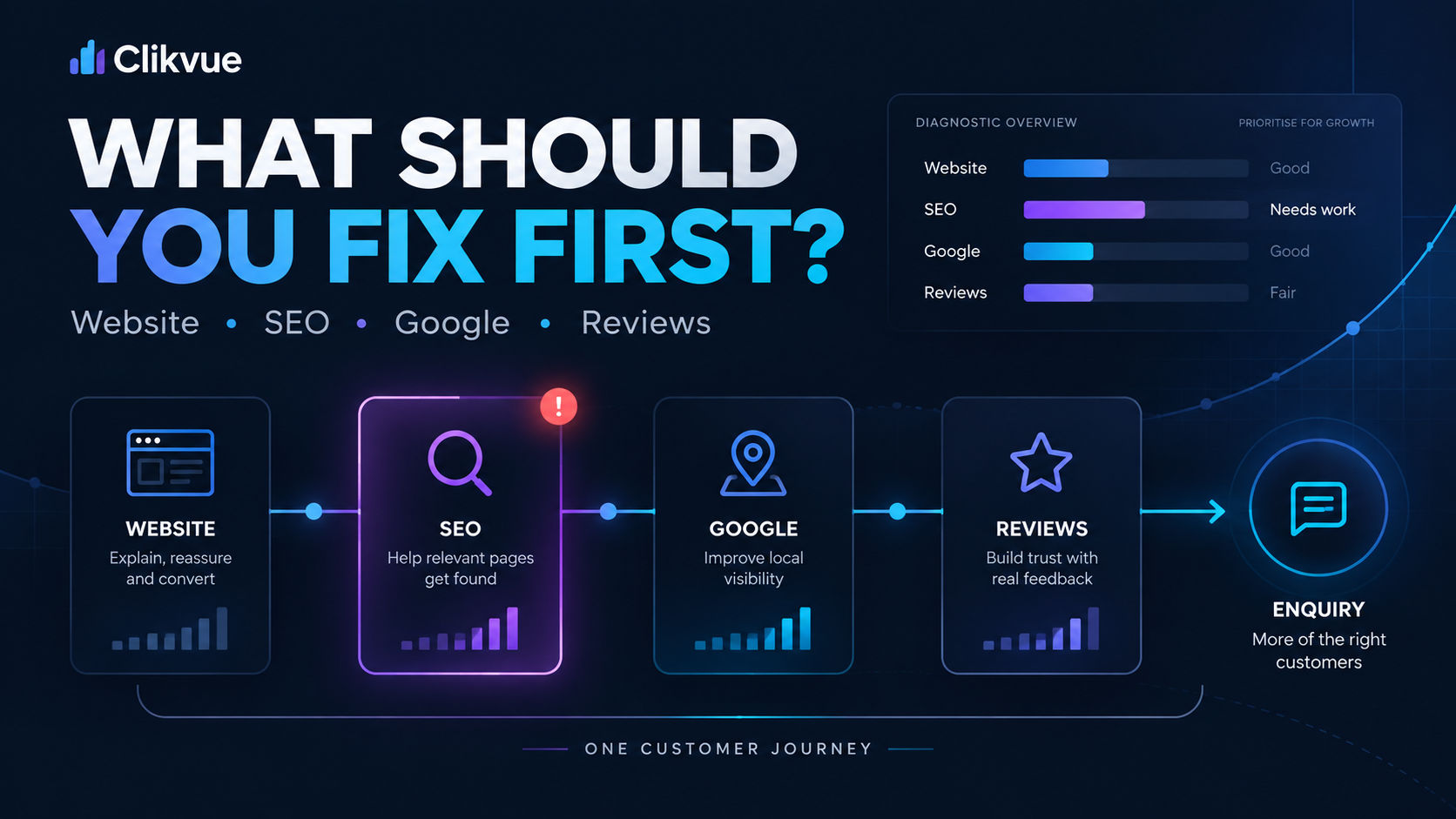
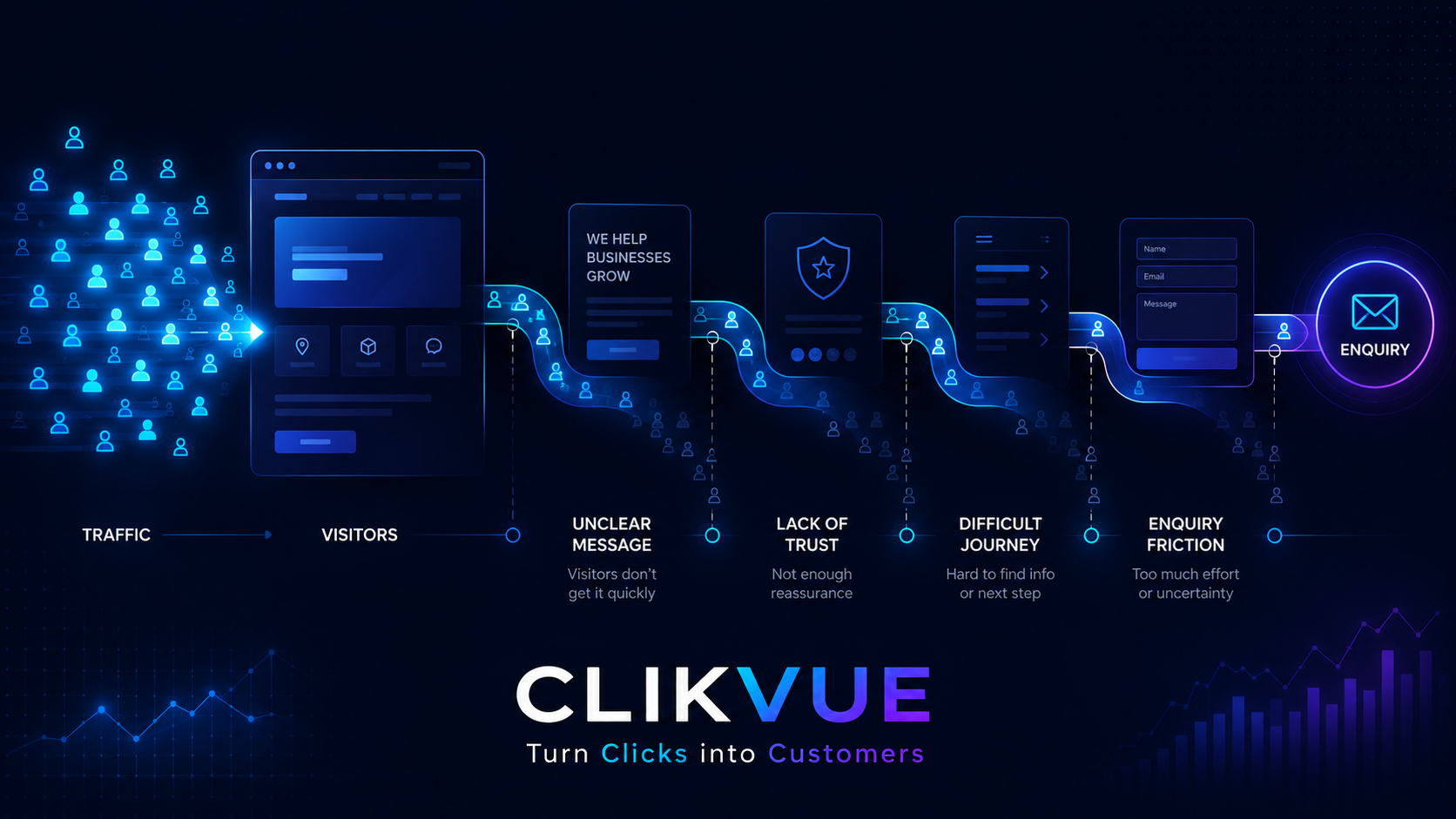
Getting found doesn't mean they're ready to contact you.
Each stage needs to give the customer a reason to keep going.
Every stage matters. A customer can lose confidence anywhere between finding you and making an enquiry.
5. Can they understand what happens next?
Customers do not necessarily expect every local business to publish a fixed price list.
A building project, legal matter, electrical job or bespoke service may genuinely need to be discussed first.
But customers still want some idea of what happens next.
They may be asking:
- Do I need to request a quote?
- Is the initial consultation free?
- Will somebody visit me?
- How quickly will I hear back?
- What information do you need from me?
- Do prices start from a particular amount?
- Is there a call-out charge?
- Can I book online?
Clear pricing or offers were among the stronger factors influencing which local business consumers chose in BrightLocal's 2026 research.
You do not need to invent fixed pricing where it would be misleading.
You do need to reduce unnecessary uncertainty.
For example:
Prices depend on the size and condition of the property. Request a free quote and we will normally respond within one working day.
is far more useful than:
Contact us for more information.
The customer understands what they are being asked to do and what happens afterwards.
6. Does the website answer their obvious questions?
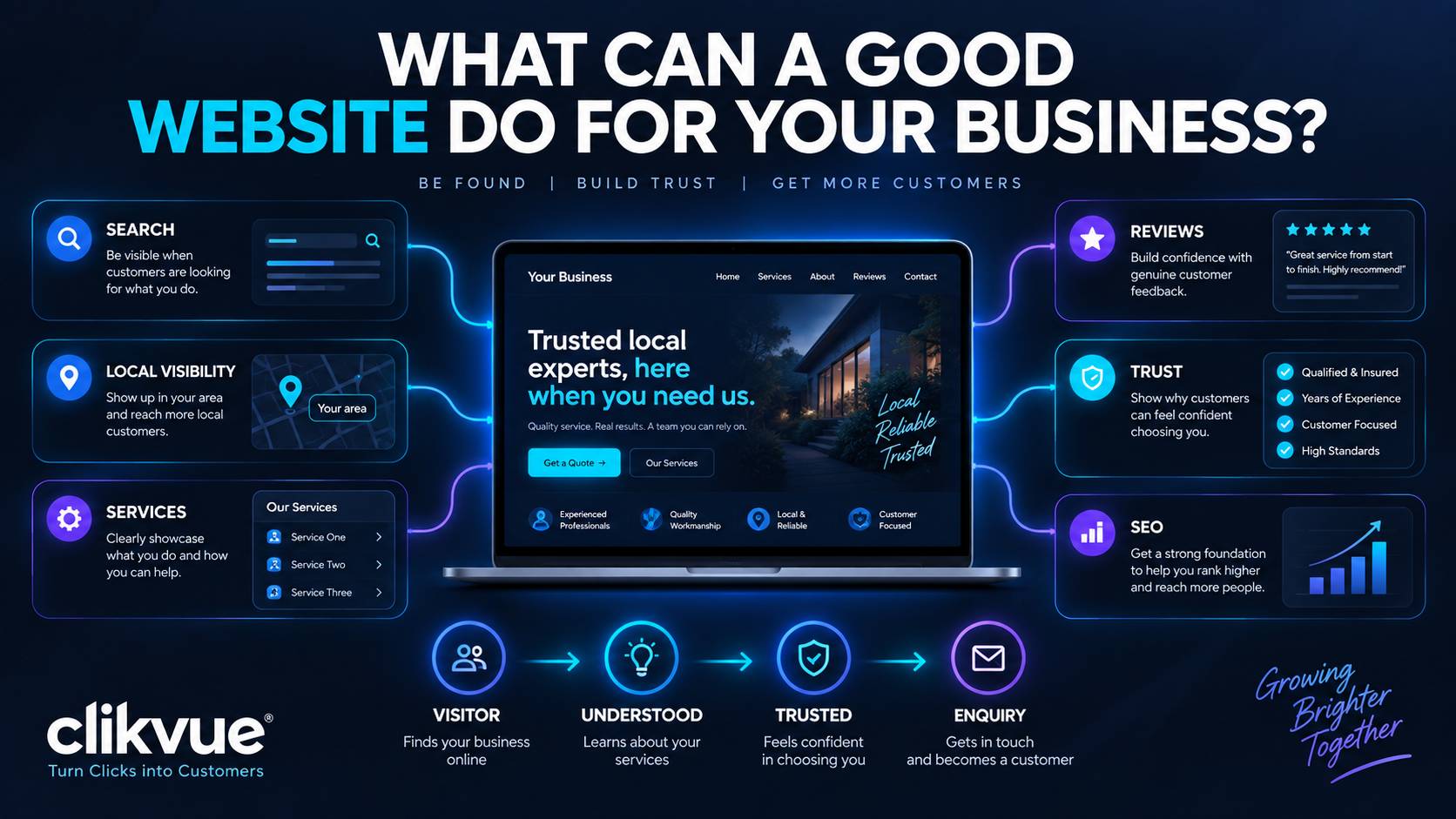
A good local business website should do some of the selling before the customer speaks to you.
Not through aggressive sales copy.
Through useful information.
Think about the questions customers repeatedly ask when they phone or email you.
Those questions often belong somewhere on your website.
A kitchen fitter might need to explain how long projects normally take.
A clinic might need to explain what happens during the first appointment.
A solicitor might need to explain whether an initial consultation is available.
A heating engineer might need to clarify which boiler brands they work with.
An accountant might explain which types of businesses they support.
Answering questions like these does two things.
It helps qualified customers feel more comfortable contacting you, and it allows unsuitable enquiries to filter themselves out.
Both are useful.
Remember
Customers rarely leave because your website is missing a clever feature.
They leave because something they needed to know was unclear, difficult to find or gave them a reason to hesitate.
7. Is the business information consistent?
Customers increasingly move between several sources before choosing a business.
BrightLocal's 2026 research found that 75% of consumers used more than one channel during their most recent local business search. Google remained the main starting point, while Maps, social media, review sites and AI tools were also used during the wider research process.
Another BrightLocal study found that consumers regularly checked whether important business information matched across different online sources.
Think about what happens when somebody finds:
- one phone number on Google
- another on your website
- different opening hours on Facebook
- an old address on a business directory
- services mentioned in one place but nowhere else
None of those problems feels dramatic by itself.
Together, they create doubt.
Customers should feel as though they are looking at the same business wherever they find you.
That means periodically checking your business name, contact details, service information, opening hours, location information and key messaging across your main online profiles.
8. Can they see real evidence of your work?
Customers are rarely expecting Hollywood-quality photography.
They are looking for evidence.
For many local businesses, useful photographs could include:
- completed projects
- before-and-after examples
- your premises
- your team
- equipment or vehicles
- treatment rooms
- products
- recent jobs
- examples of the process
Google encourages businesses to add photographs and videos to their Business Profiles because they help customers understand what the business offers.
Real photographs are particularly valuable for businesses where customers are trying to assess quality before making contact.
A landscaper's completed gardens tell a stronger story than a generic photograph of somebody mowing grass.
A salon's real work is more convincing than a stock photograph of a model.
A builder's completed extension provides evidence that the business actually carries out the work it advertises.
You do not need hundreds of images.
You need enough genuine proof to make the business feel real.
9. Does contacting you feel easy?
This is where surprisingly good websites can still lose enquiries.
Someone has decided they like the business.
Then they reach the contact stage.
The phone number is difficult to find.
The contact form asks for twelve pieces of information.
The mobile menu hides the booking button.
There is no indication when anybody will reply.
Or every page ends without telling the visitor what to do next.
That is unnecessary friction.
Your main call to action should normally match the way customers prefer to buy your service.
That might be:
Call now
Request a quote
Book an appointment
Check availability
Send us your project details
There can be secondary options, but avoid making customers choose between six equally prominent buttons.
On mobile, important contact actions should be especially easy to use.
BrightLocal's 2026 consumer research found that 73% of respondents started their most recent local business search on a mobile phone.
If somebody has already done the work of finding you, checking your reviews and deciding that you look suitable, contacting you should not become the difficult part.
10. Does everything add up?
This is the bigger point.
Customers do not experience your Google Business Profile, website, reviews, photographs and contact process as separate marketing channels.
They see one business.
One part can strengthen another.
Good reviews encourage somebody to visit the website.
A useful website answers questions raised during their Google search.
Real photographs support the claims made in your copy.
Clear service areas confirm that you are relevant.
Simple contact options make it easy to act once enough confidence has been built.
BrightLocal's 2026 review research found that 54% of consumers visited a business's website after reading positive reviews, showing how closely these different parts of the journey can connect.
That is why improving online visibility alone does not automatically mean more enquiries.
You also need to consider what customers find once you become visible.
A simple way to review your own business
Try looking at your online presence as though you have never heard of the company before.
Search for the main service you offer.
Find your business.
Then ask:
- Is it immediately clear what we do?
- Is it obvious which areas we serve?
- Do the reviews make the business feel active?
- Can I see genuine proof of the work?
- Are the important contact details accurate?
- Can I understand roughly what happens after I enquire?
- Does the website answer my biggest questions?
- Is contacting the business easy on a phone?
- Does the information match across Google and the website?
- If I compared this with two competitors, would there be an obvious reason to choose us?
Do not evaluate it as the business owner.
You already know what your company does, how trustworthy you are and how the enquiry process works.
A new customer knows none of that.
The 10-Minute Customer Check
Look at your business as if you were a new customer. How many of these can you confidently tick?
A new visitor can quickly understand your main services.
Customers can immediately see whether you serve their location.
Your phone, address and business details are consistent online.
There is current evidence that real customers are using you.
Your website or profile includes genuine proof, photos or examples.
Customers understand roughly what happens before they enquire.
The website covers the things customers usually ask you about.
Calling, booking or requesting a quote is simple on a phone.
Your services, location and key business information are consistent.
The customer knows exactly what to do when they are ready.
Any unchecked box is a potential point of friction. It may be giving a customer a reason to hesitate, compare another business or leave.
Before someone contacts you, they are usually trying to answer five things:
RELEVANT
Do you offer what I need?
LOCAL
Do you cover my area?
TRUSTED
Can I rely on you?
CLEAR
Do I understand what happens next?
EASY
Can I contact you without hassle?
2. Are you genuinely relevant to their location?
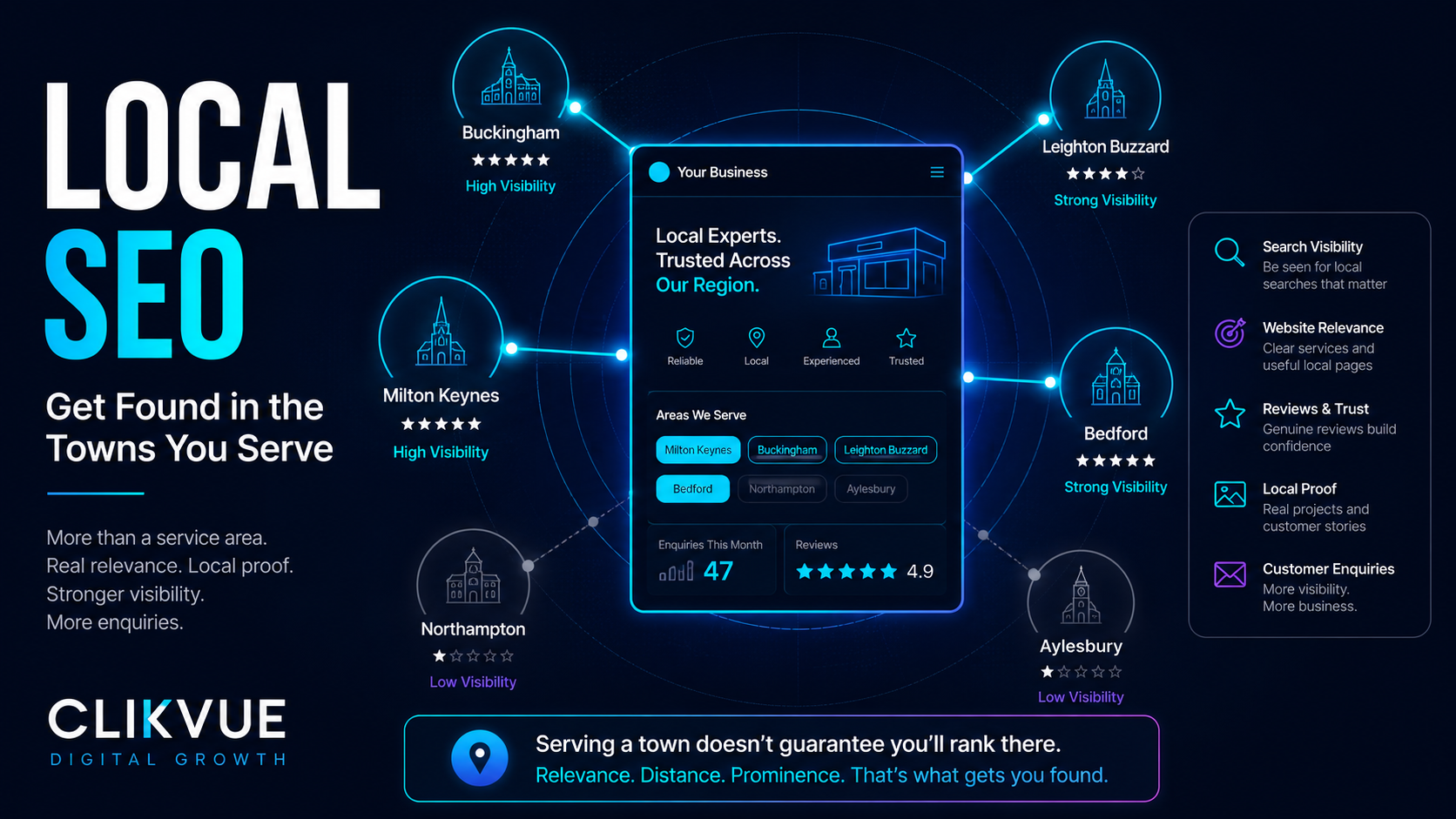
For a local business, distance matters.
BrightLocal's 2026 consumer research found that the address or proximity of a business was the most commonly considered factor during the research stage, mentioned by 44% of respondents.
Customers want to know whether you are actually nearby or genuinely serve their area.
A homeowner in Milton Keynes looking for a roofer does not want to spend five minutes exploring a website before discovering that the company only works around Oxford.
Make your service area obvious.
That could mean displaying the areas you cover on your homepage, creating genuinely useful location pages for important areas or clearly explaining your service radius.
Your Google Business Profile should also contain accurate location or service-area information.
Google itself recommends keeping business information complete and accurate, including addresses, phone numbers, business categories and opening hours.
The important point is not to create dozens of near-identical town pages simply to mention every location you can drive to.
Instead, make it easy for real customers to answer:
“Will this company actually come to me?”
3. Does the business look active and trustworthy?
Once someone knows you provide the right service, the next question becomes:
“Can I trust these people?”
This is where several parts of your online presence begin working together.
Customers might look at:
- your Google reviews
- how recently those reviews were posted
- your overall rating
- photos of your work
- testimonials
- qualifications or accreditations
- examples of previous customers
- how professionally your website presents the business
- whether your contact and company information looks legitimate
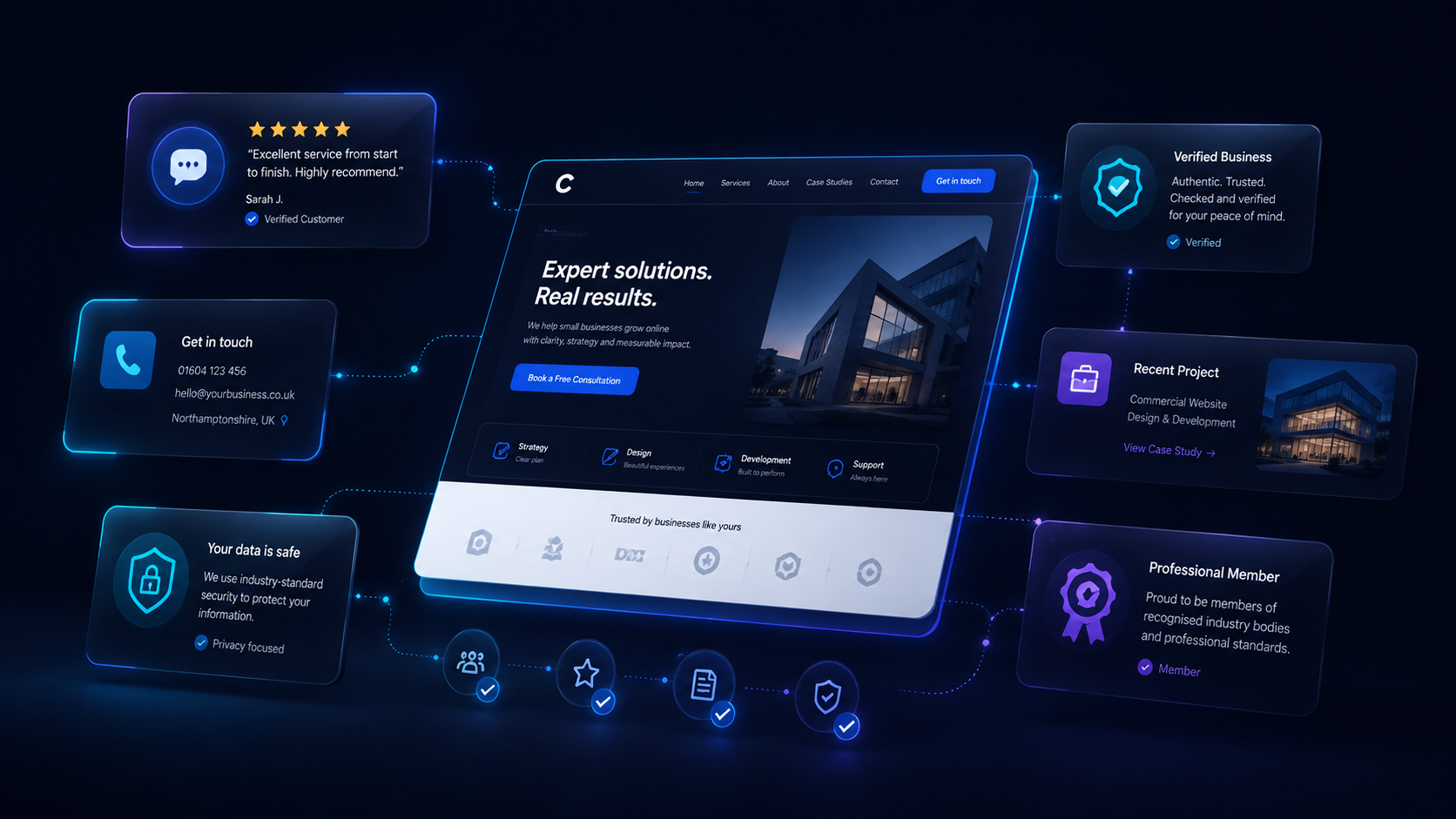
No single trust signal normally makes the decision by itself.
Customers build confidence from the overall picture.
A polished website with no reviews can create doubt.
Dozens of excellent reviews connected to a confusing or outdated website can do the same.
A strong online presence feels consistent.
The services described on Google match the website. The photographs look believable. Reviews mention the same work you advertise. Contact details are consistent. The business looks active rather than abandoned.
That consistency helps reduce uncertainty.
If you want to examine this part of your website more closely, our guide to 11 trust signals every small business website should have covers the main areas worth checking.
4. What are other customers saying?
Reviews are now part of the research process for a huge number of customers.
BrightLocal's 2026 Local Consumer Review Survey found that 97% of respondents read reviews for local businesses. The same research found that customers looked at more than the headline rating. They also paid attention to things such as recent reviews, repeated themes in customer feedback and whether business owners responded.
That distinction matters.
Five stars alone do not tell the entire story.
Imagine two local businesses.
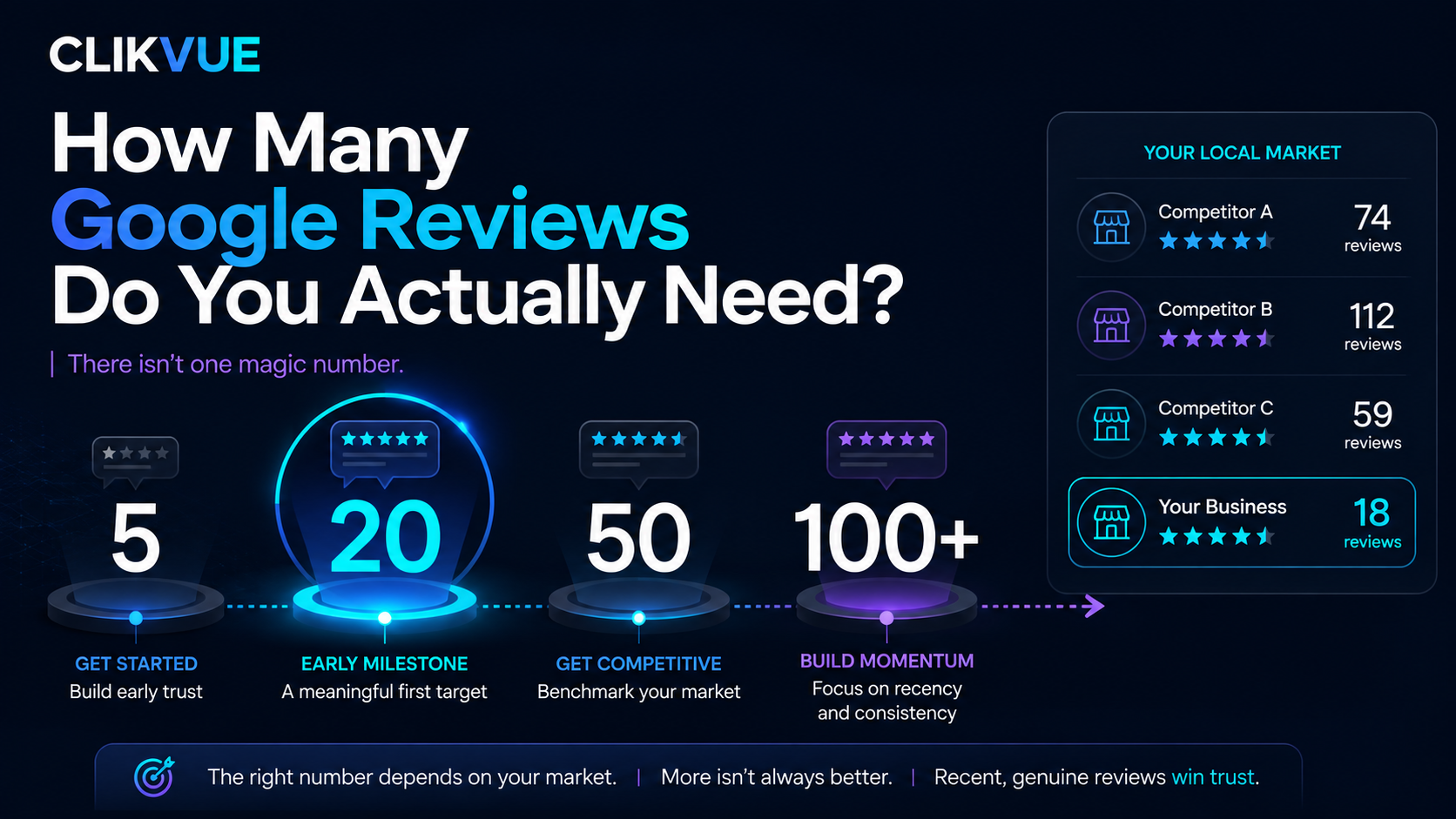
One has a 4.9 rating from eight reviews, with the most recent review posted two years ago.
Another has a 4.7 rating from 130 reviews, including several detailed reviews from the past few weeks.
Depending on the service, the second business may feel much safer.
Customers can see evidence that people are still using it.
The wording of reviews matters too.
A detailed review saying:
They replaced our boiler, explained the different options clearly, arrived when promised and left everything tidy.
is much more useful to another customer than:
Great company. Five stars.
Detailed reviews help potential customers understand what the experience of working with you is actually like.
Businesses should therefore think beyond simply accumulating the largest possible review count.
Aim for a steady flow of genuine customer feedback and respond naturally when customers leave it.
If reviews are an area you are working on, you can also read How many Google reviews does a small business need?.
Being found is only the first step
A potential customer may discover your business through Google, Maps, a recommendation, social media, AI search or a review site.
After that, they begin looking for reasons to either continue or leave.
They want clarity.
They want evidence.
They want reassurance that you operate where they need you.
They want to see that other customers have had good experiences.
And when they are ready, they want an obvious way to contact you.
You do not need the biggest website, hundreds of reviews or an enormous marketing budget to provide those things.
You need an online presence that answers the customer's questions before those questions become reasons to choose somebody else.
Not sure what customers see when they find your business?
Clikvue's £100 Snapshot Report reviews the important parts of your online presence, including your website, Google visibility, trust signals, reviews and the journey customers take before contacting you.
The aim is simple: identify where potential customers may be losing confidence and give you practical areas to improve.
If you would rather start with a quick check yourself, you can also take the free Clikvue Growth Score assessment.
Resources
Google Business Profile Help
Official guidance from Google on keeping your Business Profile accurate, adding photos, managing reviews and updating business information.
https://support.google.com/business/answer/7091?hl=en-uk
11 Trust Signals Every Small Business Website Should Have
A Clikvue guide to the website elements that can help potential customers feel more confident about contacting your business.
https://www.clikvue.com/growth-hub/11-trust-signals-small-business-website
How Many Google Reviews Does a Small Business Need?
A practical look at review quantity, quality, recency and what customers may consider when comparing businesses.
https://www.clikvue.com/growth-hub/how-many-google-reviews-small-business-need
Sources
BrightLocal: Consumer Search Behavior 2026
Research into how consumers discover, research and choose local businesses.
https://www.brightlocal.com/research/consumer-search-behavior-decisions/
BrightLocal: Consumer Search Behavior — Channels 2026
Research covering Google, Maps, websites, social media and the different channels consumers use during local business searches.
https://www.brightlocal.com/research/consumer-search-behavior-channels/
BrightLocal: Local Consumer Review Survey 2026
Research into how consumers read and use reviews when deciding which local businesses to contact.
https://www.brightlocal.com/research/local-consumer-review-survey/
Google Business Profile Help
Google's guidance on maintaining accurate business information, reviews, photos and other profile details.
https://support.google.com/business/answer/7091?hl=en-uk
Recent Posts