CLIKVUE GROWTH HUB
Does Your Small Business Really Need a Website? Here’s What a Good One Can Do
Does your small business really need a website? Here’s what a good one can do
You can run a business without a website.
Plenty of small businesses get their first customers through recommendations, Facebook, Instagram, local directories, Google Business Profile or simply years of reputation in their area.
So if work is already coming in, it is reasonable to ask whether building a website is really necessary.
The better question is not simply whether your business needs a website.
It is what a good website could help your business do that you cannot easily achieve elsewhere.
A website gives you a place to properly explain what you offer, show where you work, answer customer questions, demonstrate why people should trust you and give potential customers a clear way to take the next step.
It can also become the central point connecting everything else you do online.
Someone discovers you on Google.
Someone sees your van.
A friend recommends you.
Someone finds your Facebook page.
Someone sees one of your reviews.
They search for your business and arrive at your website.
What happens next matters.
Your website gives interest somewhere to go.
Customers can discover your business in different ways. Your website is where that interest can turn into understanding, trust and an enquiry.
WEBSITE
More UK businesses are building an online presence
Websites are already a normal part of doing business in the UK.
The UK Business Data Survey 2026 found that 78% of UK businesses reported having a website, up from 68% in the previous survey. Among small businesses with 10 to 49 employees, that figure rises to 92%.
There are still some noticeable gaps. Only 65% of construction businesses surveyed reported having a website, for example.
That is particularly relevant for trades and local service businesses.
A plumber, electrician, landscaper, decorator or heating engineer might already get a steady flow of work from recommendations. But when someone who does not already know the business starts looking online, there is much less information available to help that person decide whether to make contact.
At the same time, search remains a major part of how people navigate the internet.
Ofcom reported that Google Search was used by 82% of UK online adults in 2025. Google Maps was also one of the UK's most commonly used smartphone apps.
Being visible where customers are looking matters.
But being found is only the first step.
A website gives interested customers somewhere to go
Imagine somebody has been recommended your business.
They have your name, but they do not know much else about you.
There is a good chance they will search for you.
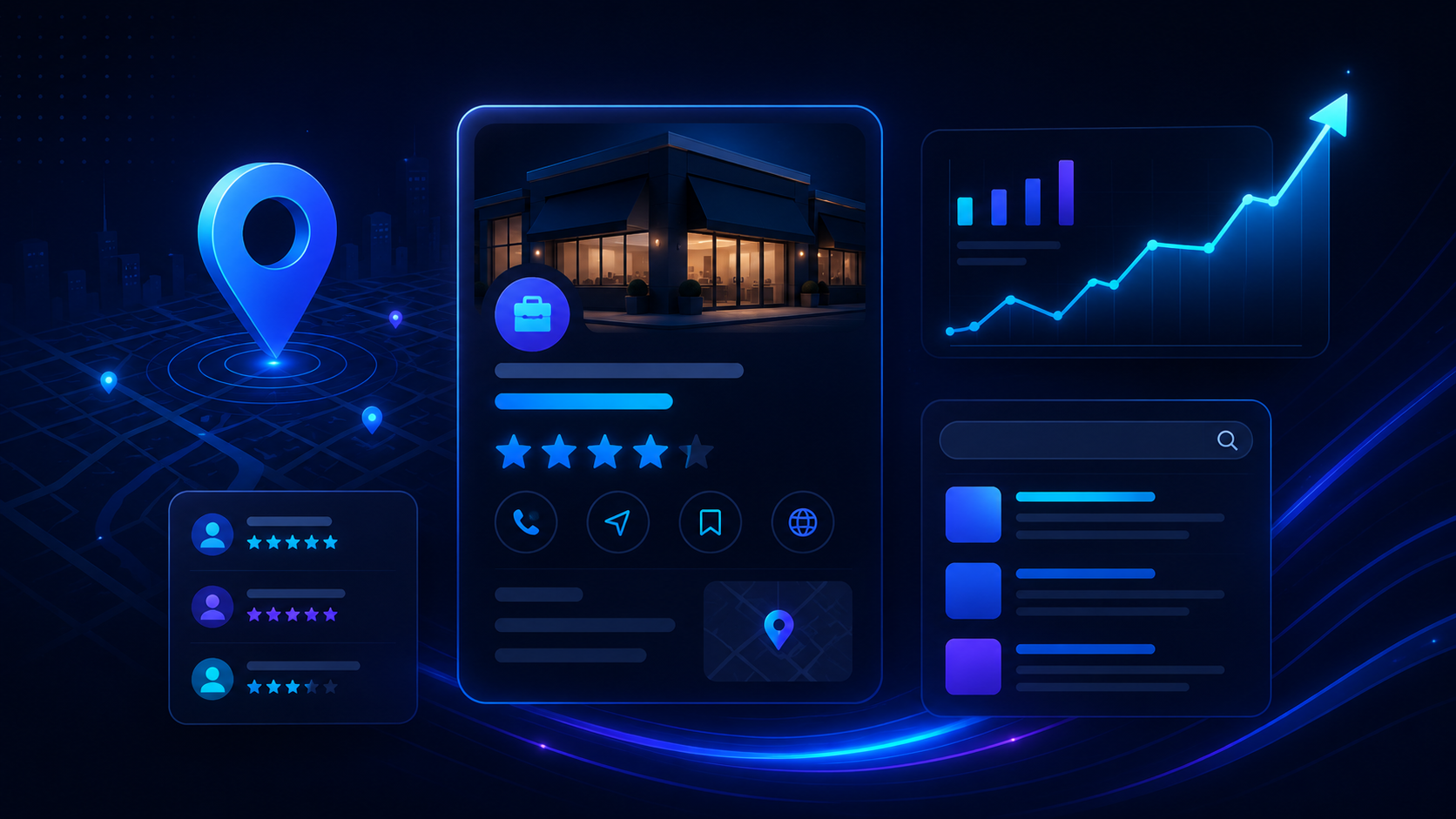
Maybe they find your Google Business Profile. They might see your reviews, opening hours, photographs and phone number.
That is useful information.
Google itself describes Business Profiles as a way for businesses to appear across Search and Maps, provide important information and direct potential customers onwards to a website, booking link or other destination.
Your website then has an opportunity to take that interest further.
Instead of expecting someone to make a decision based on a handful of search results, you can give them somewhere to properly explore the business.
They can see:
- what you do
- which services you provide
- where you work
- examples of previous work
- reviews and testimonials
- answers to common questions
- information about your business
- pricing or how quotations work
- accreditations or qualifications
- how to contact or book with you
Your website does not replace Google, social media or reviews.
It gives all of those things somewhere to lead.
Think of your website as part of the customer journey
A customer rarely wakes up thinking, "I want to visit a business website today."
They have a problem.
They might need an emergency plumber.
A dentist.
An accountant.
A local salon.
A driving instructor.
Someone to build a new kitchen.
They start looking for someone who can help.
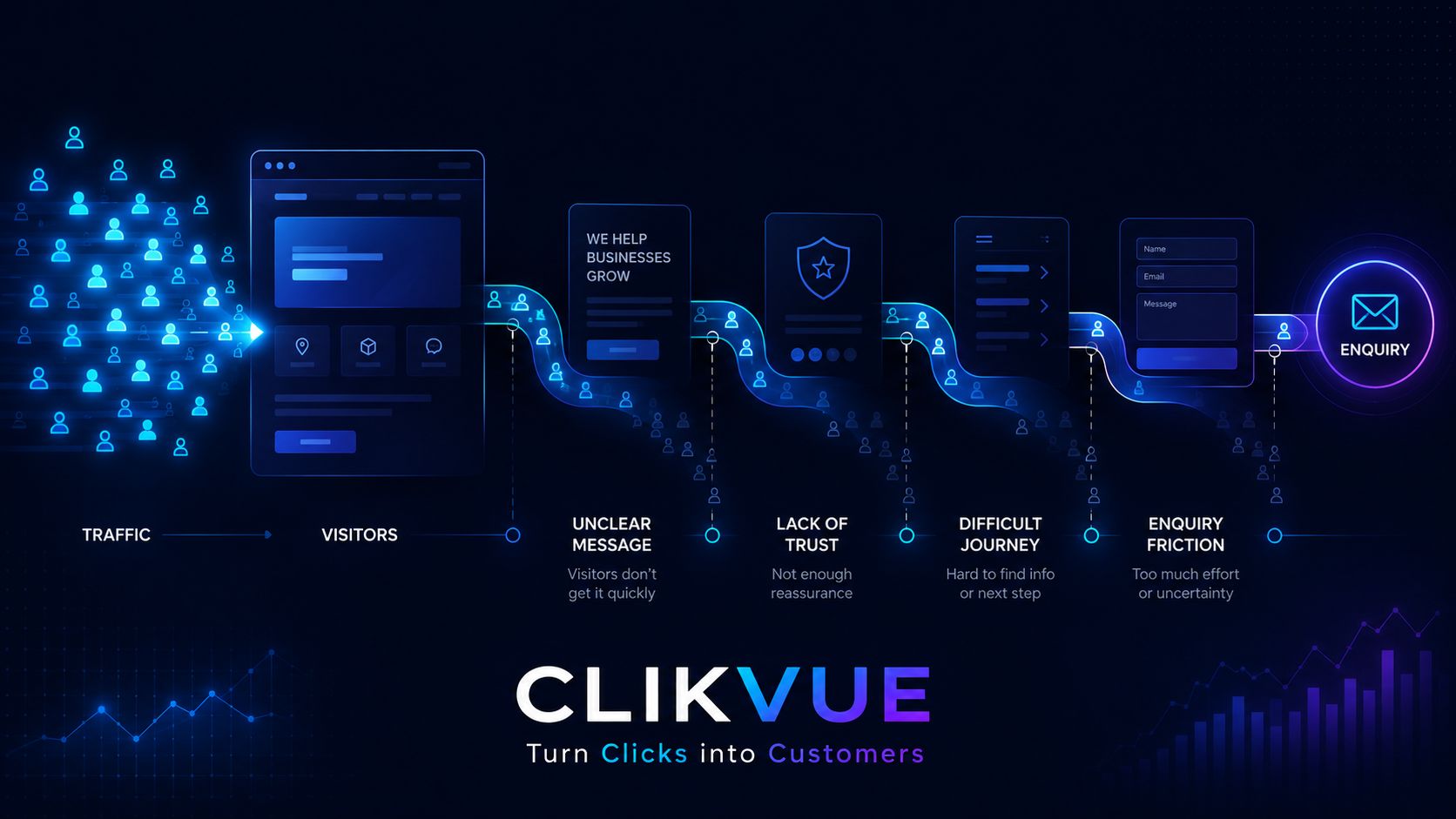
That creates a simple journey:
Found → Visited → Understood → Trusted → Enquired
Your website plays a particularly important role in the middle of that journey.
Being found might come from Google, Maps, a recommendation, social media or an advert.
The website then has to answer the questions that determine whether the customer continues.
Do they actually provide what I need?
Do they work in my area?
Do they look trustworthy?
Have they done this before?
How difficult is it to get in touch?
If those answers are difficult to find, the visitor may simply go somewhere else.
That is why having a website and having an effective website are two different things.
The most important things your website should do
You do not necessarily need dozens of pages, complicated animations or every feature available to you.
For many small businesses, getting the fundamentals right is far more valuable.
1. Make it obvious what your business does
A new visitor should not have to investigate your website to work out what you actually offer.
Your homepage should quickly answer:
What do you do?
Who do you help?
Where do you provide it?
A heading such as:
Welcome to Smith & Sons
does not tell a new customer very much.
Something closer to:
Domestic plumbing and heating services across Milton Keynes and Buckinghamshire
immediately gives them useful information.
The exact wording will differ between businesses, but clarity should come before cleverness.
2. Give your important services their own space
Trying to explain an entire business in one paragraph makes it difficult for customers and search engines to understand the different things you offer.
If you are a plumbing and heating company, boiler servicing, boiler installations, bathroom plumbing and emergency repairs may deserve their own pages.
If you are an accountant, bookkeeping, payroll, self-assessment and company accounts might each need proper explanation.
This helps potential customers find the information that matters to them.
It also gives search engines clearer information about the subjects and services your website covers.
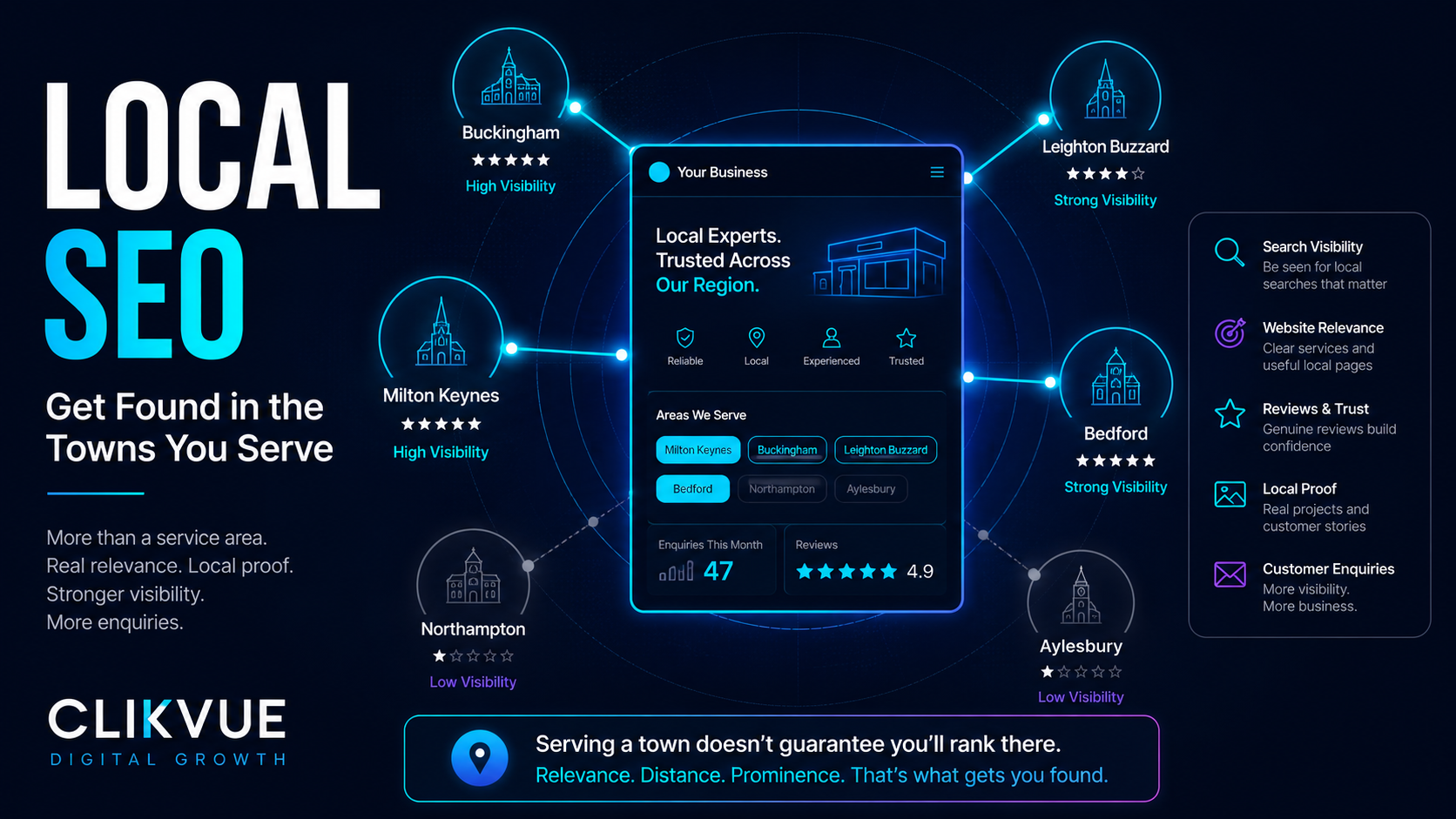
3. Make your location clear
This is particularly important for local and service-area businesses.
If somebody arrives on your website and cannot work out whether you actually serve Milton Keynes, Bedford, Watford, Northampton or the surrounding area, you are creating unnecessary uncertainty.
Your primary locations should be clear.
That does not mean creating hundreds of almost identical town pages.
It means giving people accurate information about where you genuinely work and structuring the website in a way that makes that clear.
If local visibility is an important part of your growth, you can read our guide to getting found in the towns and areas you serve.
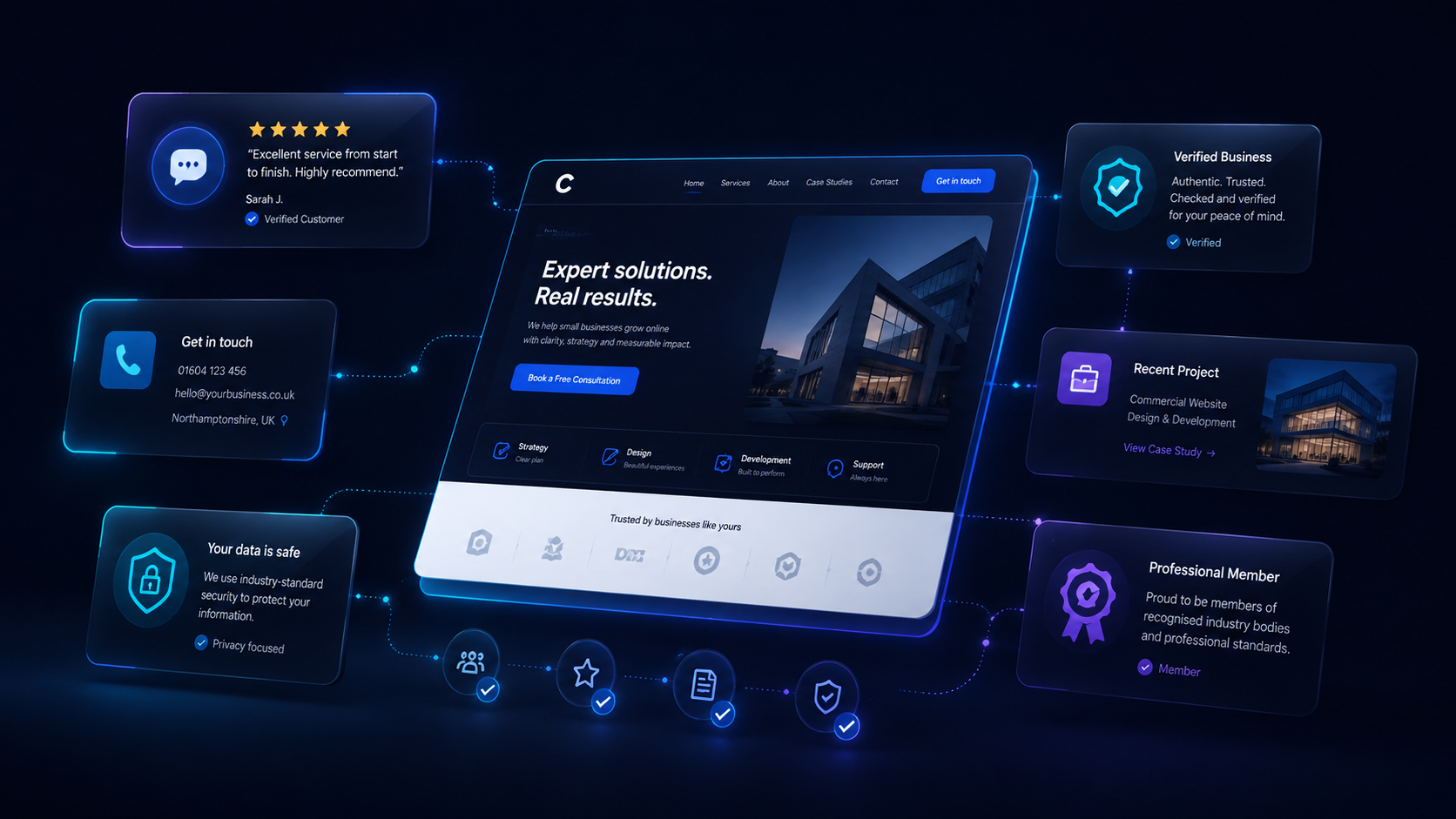
4. Give people reasons to trust you
A website gives you much more room than a search listing to explain why somebody should feel comfortable contacting your business.
That might include:
- genuine customer reviews
- photographs of previous work
- case studies
- professional memberships
- relevant qualifications
- guarantees
- years of experience
- real team information
- clear contact details
- your business address where appropriate
- policies and legal information
Not every business needs every trust signal.
The important thing is removing the questions that might otherwise make someone hesitate.
We have covered this in more detail in our guide to the trust signals every small business website should consider.
5. Make contacting you simple
Do not make someone hunt for the next step.
If the main action you want people to take is to call, the phone number should be easy to find.
If you primarily take bookings, make the booking option obvious.
If you want quotation requests, the enquiry process should be straightforward.
On mobile in particular, unnecessary steps can make something that should be easy feel like work.
Can a new visitor answer these three questions quickly?
Your main service should be immediately clear.
Make your location or service area easy to find.
Calling, booking or enquiring should feel obvious.
You’re giving visitors a strong starting point.
6. Make sure the website works properly on mobile
A website might look great on a large desktop screen and be frustrating on a phone.
Text can become difficult to read.
Buttons can become too small.
Forms can become awkward.
Menus can become confusing.
Important information might disappear halfway down a very long page.
A good mobile website should feel like it was designed for the smaller screen rather than simply squeezed into it.
Google's Search guidance also recommends that sites are secure, fast, accessible and work across devices.
7. Build SEO into the website from the beginning
SEO is often treated as something you add once a website is finished.
That is backwards.
The structure of the website itself affects how clearly both people and search engines can understand it.
The pages you create, the subjects they cover, how those pages connect, the headings you use, the URLs, the content, the locations mentioned and the technical setup all contribute to the foundation SEO has to work with.
Google's own SEO Starter Guide recommends organising sites logically so that users and search engines can understand how pages relate to each other. It also recommends descriptive URLs and useful, people-focused content.
None of this means adding a location or keyword into every sentence.
It means thinking about search visibility while the website is being planned rather than trying to repair the structure afterwards.
REMEMBER
SEO shouldn't be something you bolt onto a finished website.
Your services, pages, locations, structure and content all influence how clearly customers and search engines can understand your business.
Your website and Google presence should work together
For a local business, it is rarely a choice between having a website or having a Google Business Profile.
Ideally, they support each other.
Your Business Profile can help someone discover the business in Google Search or Maps.
They may see:
- your reviews
- business category
- photographs
- opening hours
- service area
- telephone number
- directions
- website
If they want more information, your website gives them somewhere to continue.
Google can also use information from multiple sources when building and displaying business information, including information from official business websites and other publicly available sources.
Keeping the information across your online presence accurate and consistent makes the whole experience easier to understand.
Think about it as one connected system:
Google visibility → Website → Reviews and proof → Enquiry
Customers do not care which part of your marketing they are looking at.
They see one business.
What if most of your work already comes from recommendations?
This is one of the strongest arguments against building a website, and it is worth taking seriously.
If your diary is full for the next six months entirely through word of mouth, investing heavily in marketing may not be your immediate priority.
But referrals and websites are not competing with each other.
They often work together.
Someone recommends your business.
The person being referred searches your name.
They find your website.
They look at your work.
They check your reviews.
They confirm that you cover their area.
They get in touch.
The recommendation created the interest.
Your online presence helped reinforce it.
A good website can also help you move beyond relying entirely on people who already know somebody who knows you.
That matters when you want to grow into a new area, promote a particular service, attract more valuable work or simply create a more predictable source of new enquiries.
Can you just build the website yourself?
Absolutely.
There are more tools than ever for building a basic website without hiring a professional.
For a new business with a very limited budget, getting something simple online yourself may be a perfectly sensible starting point.
The difficulty comes when expectations increase.
You might eventually want the website to:
- appear for relevant searches
- target several services
- support multiple locations
- generate quotation requests
- build trust
- track enquiries
- connect with your Google presence
- load quickly
- work properly across devices
- grow as the business grows
At that point, the project becomes less about choosing a nice template and more about planning how the website should work for the business.
A professionally built website should not simply look more polished.
The real value is in thinking through the structure, content, customer journey, search visibility and conversion opportunities before everything is put together.
What should you prepare before getting a website built?
You do not need to arrive with a complete website plan.
But thinking about a few things beforehand can make the process much easier.
Start with your services.
What are the main things customers actually pay you for?
Then think about your customers.
Are you mostly helping homeowners, other businesses, landlords, patients, families or a particular type of organisation?
Next, consider where you work.
Are you based in one town? Do you serve several areas? Are you nationwide?
Gather any proof you already have.
That might include customer reviews, photographs, case studies, accreditations, before-and-after examples or testimonials.
Finally, think about the action you want someone to take.
Call?
Book?
Request a quote?
Send an enquiry?
Visit your premises?
A good website project can then turn those ingredients into something much more structured.
A website should have a job
One of the easiest mistakes to make is treating the website itself as the finished objective.
You launch it.
You tick "website" off the list.
Then it sits there.
A better approach is to give it a purpose.
Maybe the goal is to generate more quotation requests for a particular service.
Maybe it is to help the business become visible across several nearby towns.
Maybe customers regularly ask the same questions and the website could answer them before they call.
Maybe your social media generates interest but there is nowhere substantial to send people afterwards.
Maybe you simply need the business to look as established online as it already is offline.
Once the goal becomes clearer, decisions about the website become much easier.
Building a website is only the beginning
Even a well-built website will not automatically generate customers the moment it goes live.
It still needs people to discover it.
That can involve local SEO, Google Business Profile optimisation, useful content, reviews, links, social media, offline promotion or other marketing depending on the business.
It can also need improvement over time.
You might discover that visitors regularly reach one page but rarely make an enquiry.
One service could start performing particularly well.
A new location might become important.
Customers might begin asking different questions.
Search behaviour can change.
The website should be able to grow alongside the business rather than becoming something nobody touches for the next five years.
That is also why we do not see websites as isolated projects at Clikvue.
Your website works better when everything around it works together.
Your website should connect with the wider parts of your online presence, helping customers move from discovery to confidence and enquiry.
WEBSITE
How Clikvue approaches small business websites
At Clikvue, we help small businesses get found online and turn more clicks into customers.
That means we look beyond how a website appears on the screen.
When planning a website, we want to understand:
- what your customers are looking for
- which services matter most to the business
- where those customers are based
- what information they need before contacting you
- what might stop them trusting the business
- how they currently discover you
- what action you want them to take
- how the website fits into your wider Google visibility and SEO
That allows the website, its content and its SEO foundations to be planned together.
Because a beautiful website that nobody finds has a problem.
A website that gets traffic but leaves customers confused has another problem.
And a business that appears in Google but gives customers nowhere useful to continue their research may be leaving opportunities on the table.
The aim is to connect those pieces.
Get found. Be understood. Build trust. Make the next step easy.
That is how a website starts becoming part of business growth rather than simply another thing the business owns.
Do you need a new website?
If you currently have no website, start by asking what you would want one to achieve.
You do not need to know exactly what pages it should contain or how it should look.
That is part of the planning process.
If you would like help working out what your business actually needs, you can book a Growth Review with Clikvue and talk it through with us.
Already have a website?
Do not assume that means this job is finished.
Look at it through the eyes of somebody who has never heard of your business before.
Can they understand what you do?
Can they see where you work?
Can they find the service they need?
Can they see reasons to trust you?
Can they easily take the next step?
Not sure what your website needs next?
You don’t need to have everything figured out before speaking to us.
If you’re unsure how well your website and wider online presence are working together, start with our free Growth Score assessment. It can help highlight areas to look at across your website, Google visibility, trust, reviews and customer journey.
Want us to take a closer look? Our £100 Snapshot Report gives you a more detailed review of what potential customers are seeing online and where there may be opportunities to improve.
And if you simply have a question, an idea for a new website, or you’re not sure what your business actually needs, we’d genuinely be happy to hear from you. You don’t need to be ready to book anything. Send us a message and tell us what you’re trying to achieve.
Your website doesn’t need to be the biggest or most complicated in your industry.
It needs to help the right people find you, understand you, trust you and take the next step.
That’s what turns a website into something useful for your business.
Resources
Clikvue Growth Score
Free assessment covering website clarity, Google visibility, trust, reviews and the wider customer journey.
Take the free Growth Score assessment
Clikvue Growth Hub
Practical guides on websites, local SEO, Google visibility, reviews, trust and generating more enquiries online.
Explore the Clikvue Growth Hub
Google SEO Starter Guide
Google’s own introduction to website structure, content and helping search engines understand your site.
Read the Google SEO Starter Guide
Google Business Profile Help
Official guidance on how businesses appear across Google Search and Maps and how customers can reach your website.
Visit Google Business Profile Help
Sources
UK Business Data Survey 2026
UK Government research covering website adoption and digital activity among businesses.
View the UK Business Data Survey 2026
Ofcom Online Nation 2025
UK research into how people use search engines, apps and other online services.
Read Ofcom’s Online Nation findings
Google Search Central
Official Google guidance used for the sections covering SEO, site structure and people-focused content.
Google Business Profile Help
Official information about Business Profiles and how Google sources and displays business information.
Recent Posts