CLIKVUE GROWTH HUB
Website, SEO, Google or Reviews: What Should You Work on First?
Website, SEO, Google or Reviews: What Should You Work on First?
Your website needs improving.
You need more Google reviews.
You should be doing SEO.
Your Google Business Profile needs work.
All four suggestions might be correct. That does not mean all four deserve your attention right now.
For a small business with limited time and budget, the more useful question is not:
“Which of these is most important?”
It is:
“What is currently stopping more potential customers from finding us, trusting us or contacting us?”
If nobody can find your business, improving the wording on your contact page will not solve the main problem.
If plenty of people already find you but your website leaves them confused, getting even more traffic may simply give more people the chance to leave.
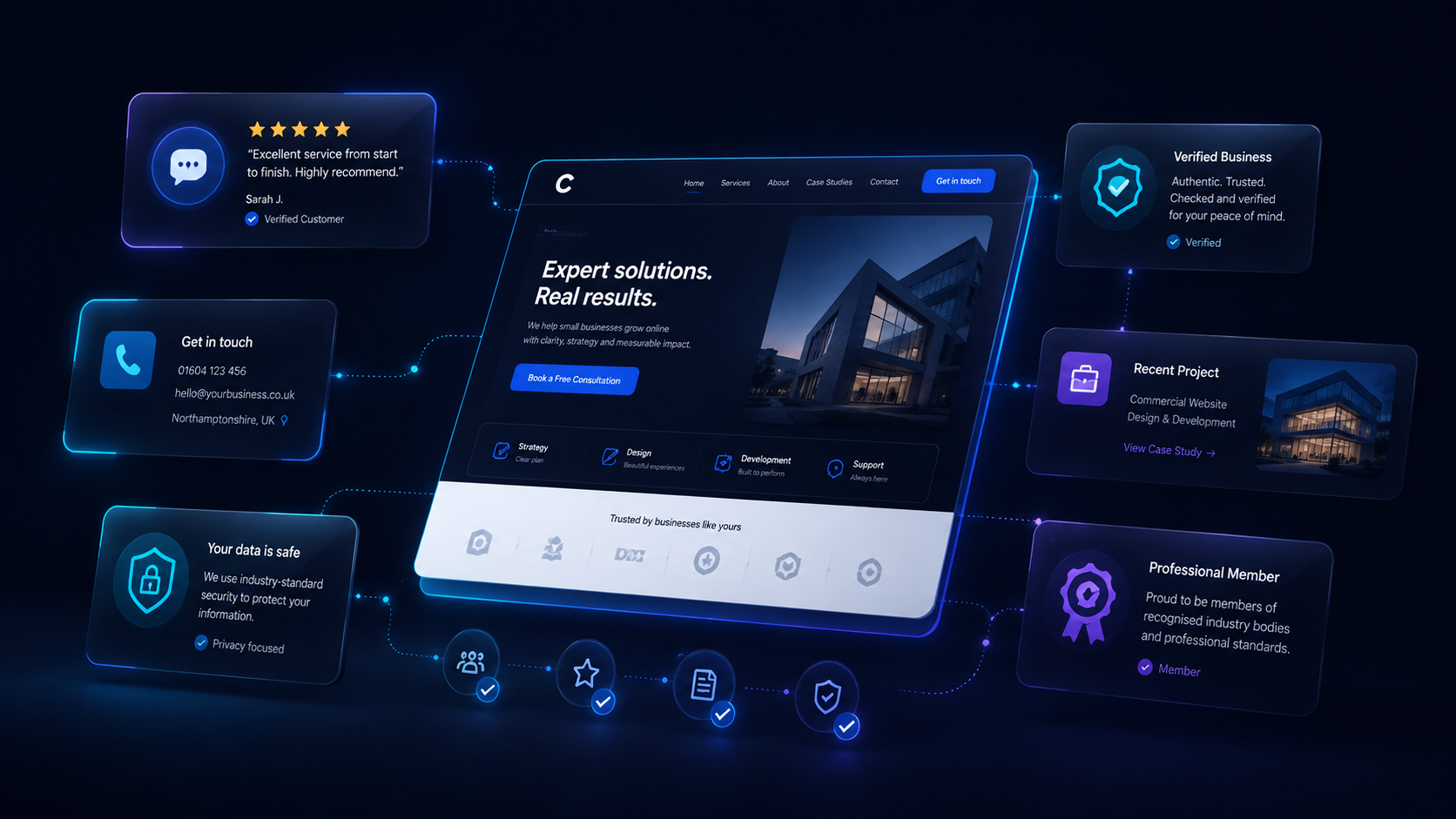
And if customers find you, understand what you do and then hesitate because there is very little evidence that other people trust you, your reviews may deserve attention before another round of SEO work.
Your priorities should follow the problem.
Website, Google, SEO and reviews do different jobs
These four parts of your online presence overlap, but they are not interchangeable.
| Area | Its main job | A problem here can look like |
|---|---|---|
| Website | Explain, reassure and turn interest into action | People visit but do not enquire |
| Google Business Profile | Help local customers discover and quickly evaluate the business | You struggle to appear in relevant local or Maps results |
| SEO | Help relevant pages become discoverable through organic search | Your website rarely appears when people search for your services |
| Reviews | Provide independent evidence that customers can trust you | People find you but have little proof that you are a safe choice |
A new website is not automatically an SEO strategy.
SEO is not simply “doing something with Google”.
Your Google Business Profile is not a replacement for a useful website.
And reviews are not only decoration to make your profile look better.
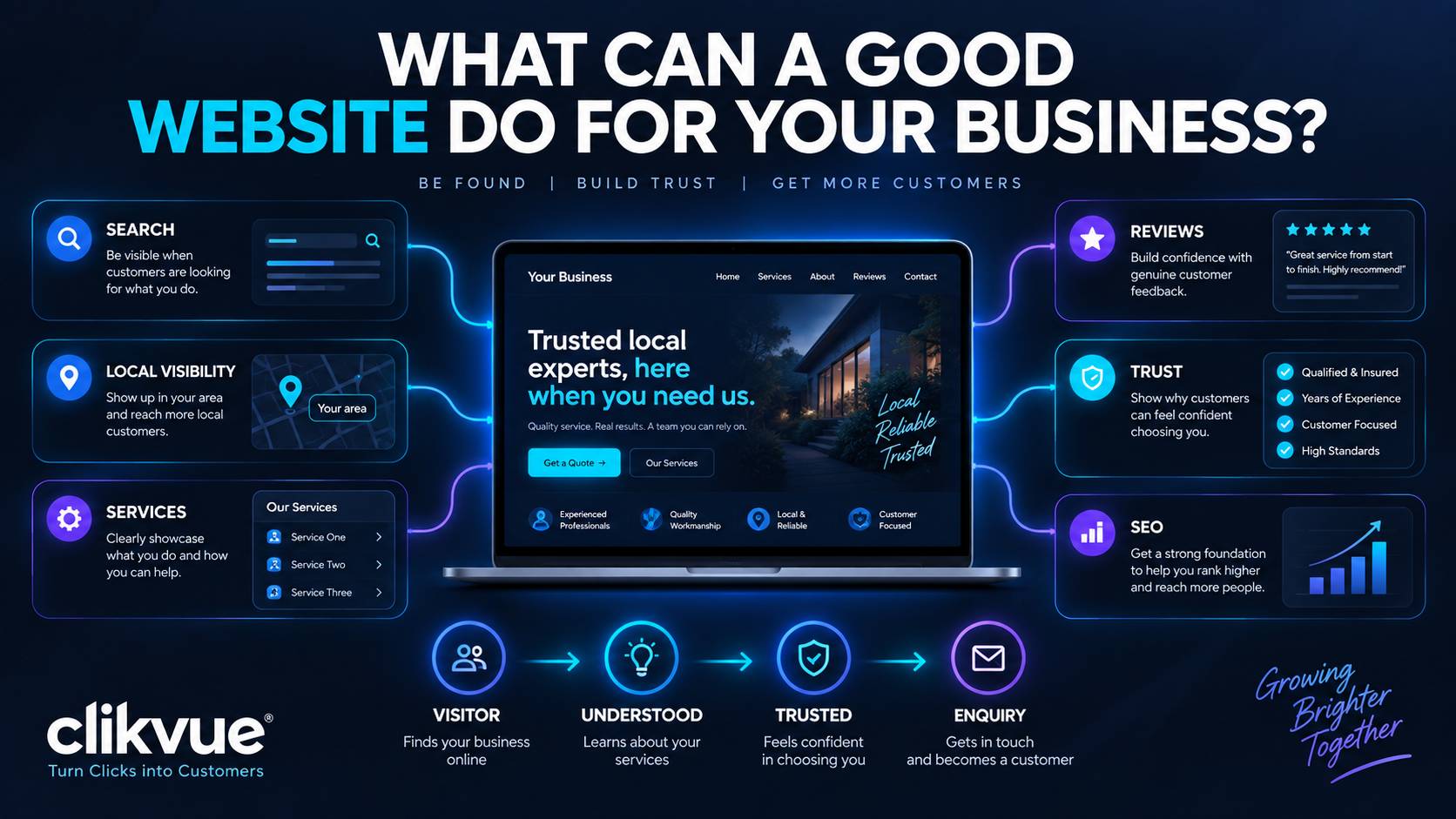
They support different stages of the same customer journey.
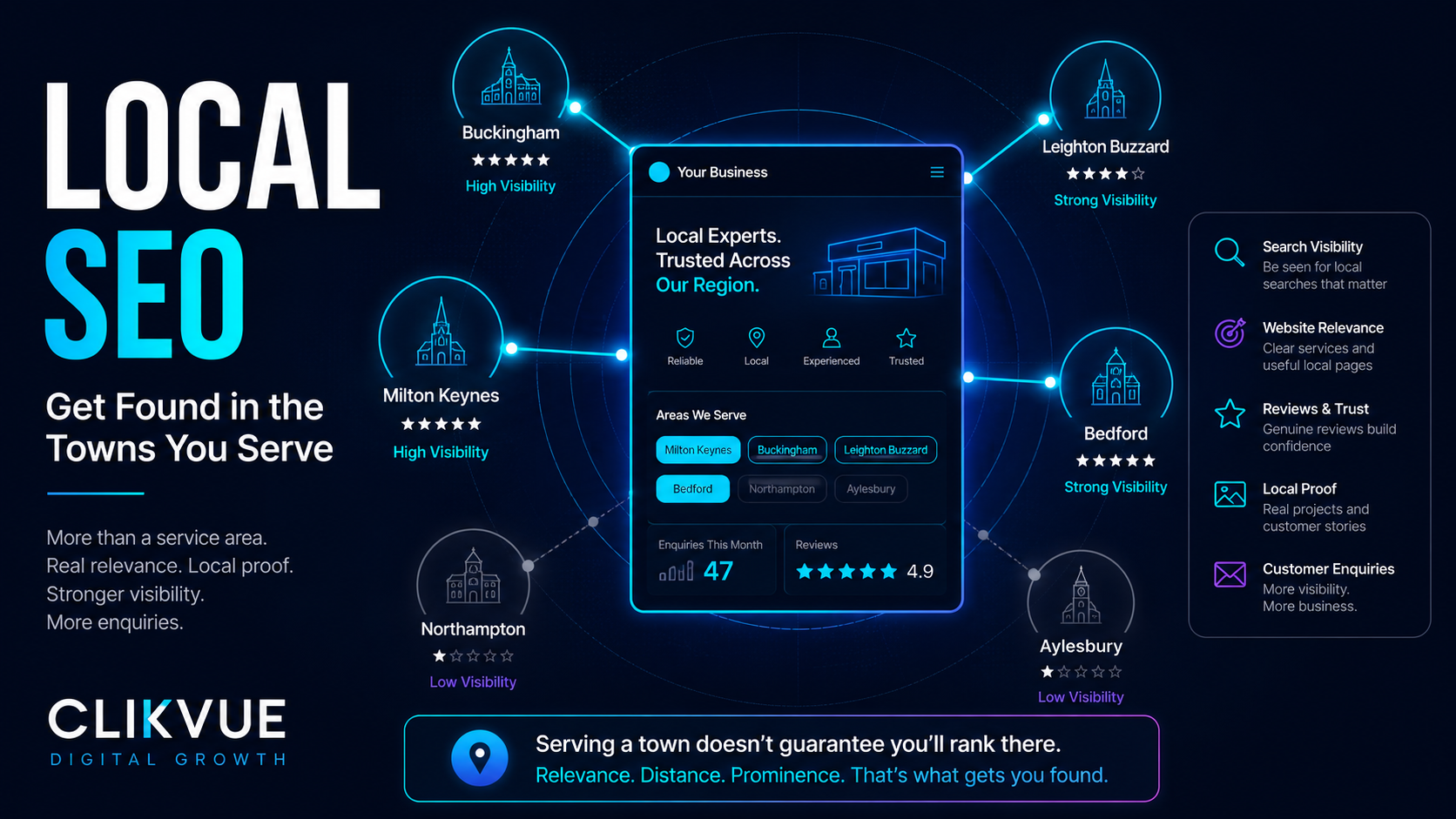
Google describes SEO as helping search engines understand your content while helping people find your site and decide whether to visit it. For local results, Google says its systems mainly consider relevance, distance and prominence. Google can also use information from a business's website and other sources when building information about that business.
The goal is therefore not to choose one of these four forever.
It is to identify where the journey is currently weakest.
Work on your website first when people arrive but do not take action
A business can have respectable Google visibility and still generate very few enquiries.
That often gets treated as a traffic problem.
Sometimes it is a website problem.
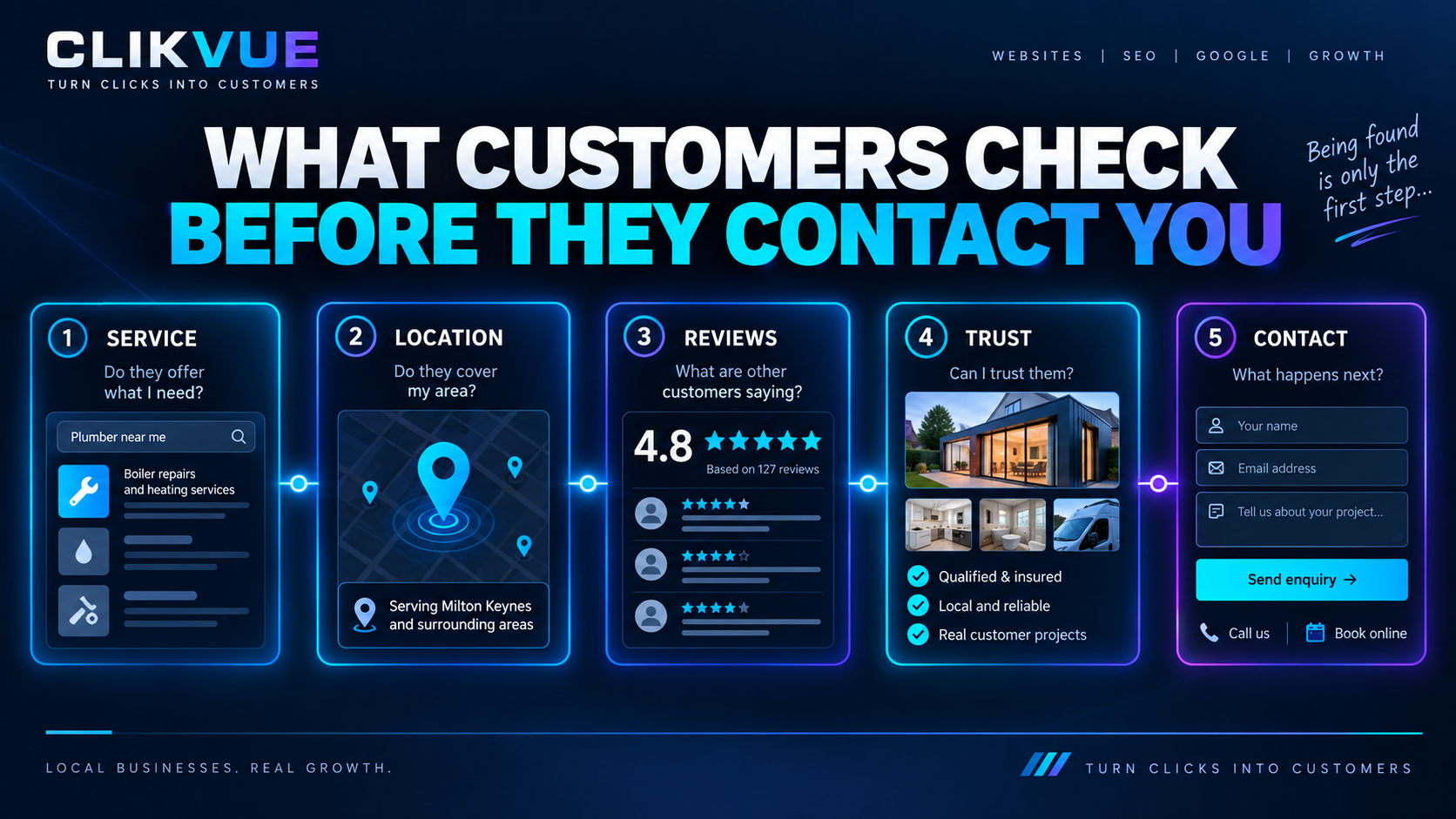
Imagine somebody searches for an emergency plumber, accountant, beauty clinic or driving instructor. They find the business and open the website.
Within a few seconds, they are trying to answer some fairly basic questions.
Do you provide the service they need?
Do you cover their location?
Do you look credible?
Why should they consider you?
And what are they supposed to do next?
If those answers are difficult to find, bringing another 500 visitors to the website does not fix the underlying problem.
The website deserves attention when it is outdated, difficult to use on a phone, unclear about services or locations, slow enough to frustrate users, thin on trust information or missing an obvious route to call, book, enquire or request a quote.
Do not confuse this with automatically needing an expensive redesign.
Sometimes the highest-impact website work is much smaller:
- rewriting the opening section
- improving a service page
- making telephone numbers easier to find
- adding genuine proof
- explaining the areas served
- simplifying the enquiry process
Google also recommends looking at the overall experience of a page rather than obsessing over one isolated metric. Its guidance includes mobile usability, security, Core Web Vitals and whether users can easily access the main content.
A good website should make the customer's next decision easier.
If yours does not, fix that before spending heavily on sending more people towards it.
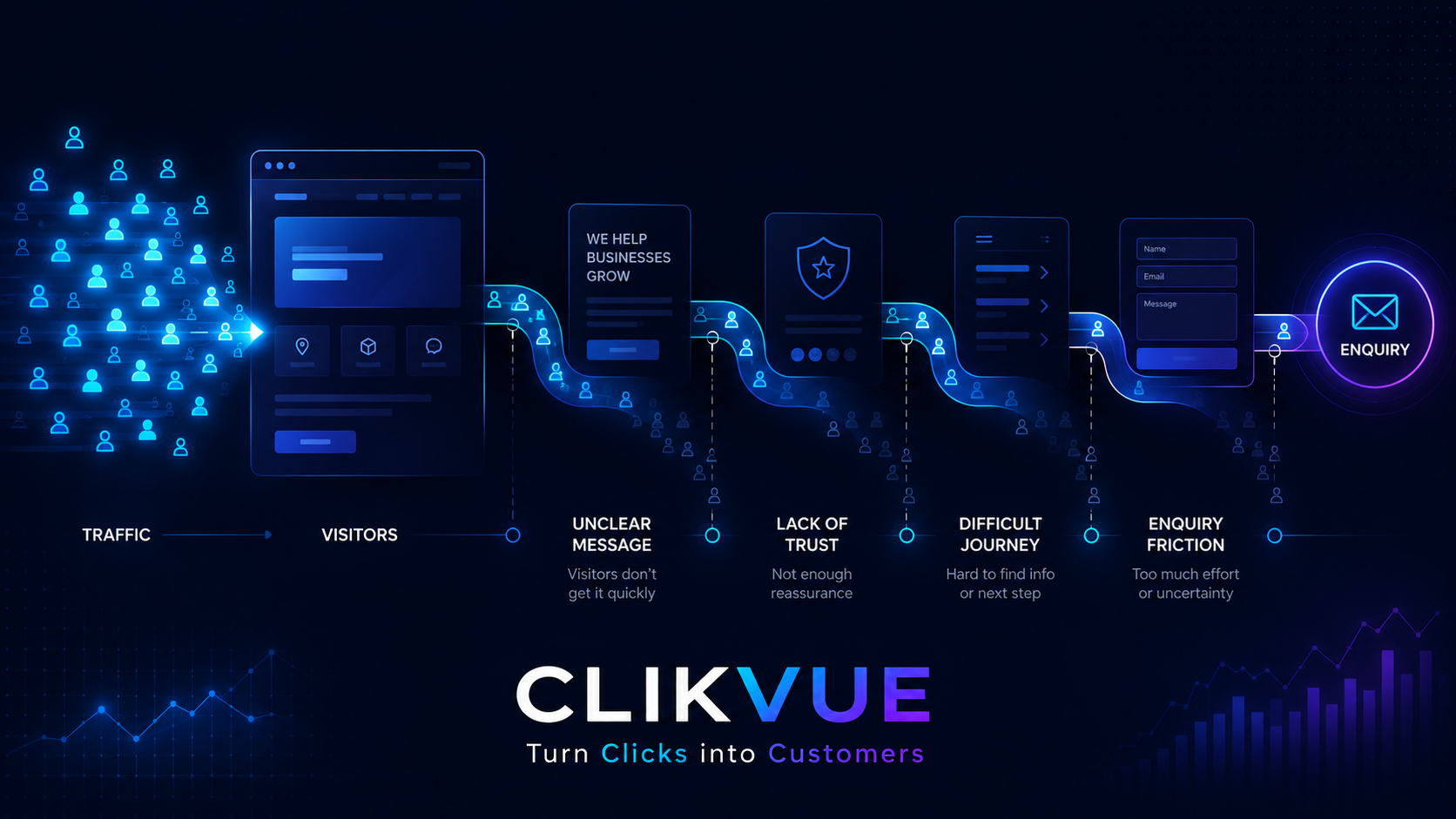
MORE TRAFFIC WON'T FIX
THE WRONG PROBLEM.
Find the bottleneck first.
Work on your Google Business Profile first when local customers struggle to find you
For many local businesses, Google Search and Maps can place the business in front of somebody at exactly the moment they are looking for a nearby service.
That makes the Google Business Profile particularly important for businesses such as trades, salons, clinics, restaurants and other location or service-area businesses.
Start here when your profile is unverified, incomplete or inaccurate, your primary business category is wrong, your opening hours or contact details are outdated, or the services and areas represented by the profile do not clearly match the real business.
Google says complete and accurate information can help businesses appear in relevant local results. Its local systems primarily consider relevance, distance and prominence.
There is an important limitation here.
You cannot optimise away distance.
A business ten miles from the person searching cannot simply change a few settings and guarantee that it outranks an equally relevant business around the corner.
Google explicitly includes distance as one of its local ranking considerations.
That is why sensible Google Business Profile work starts with accuracy and relevance rather than chasing tricks.
Get the fundamentals right first.
Then look at the wider signals supporting the profile, including your website, reviews and the information Google can find about the business elsewhere online.
Work on SEO first when your website works but too few relevant people discover it
Perhaps referrals already convert well.
Customers who know your name can find you.
Your website clearly explains your services and generates enquiries when the right people reach it.
The problem is that very few new customers discover those pages through non-branded searches.
That is where SEO becomes a stronger candidate for your next priority.
SEO can include improving how service pages are structured, creating genuinely useful content around customer questions, strengthening location relevance, improving internal links, fixing technical problems that stop pages being crawled or indexed properly, and making existing pages better match what potential customers actually need.
It does not mean creating hundreds of pages containing slightly different versions of the same keywords.
Google's own Search Essentials emphasise helpful, reliable, people-first content and using the language people actually use when searching.
It is also worth remembering that SEO is rarely instant.
Some website changes may be reflected relatively quickly, while others can take much longer to show their full effect.
That makes SEO a particularly poor choice when it is being used to avoid fixing a more obvious problem.
If your website currently confuses visitors, do not spend the next six months trying to get more of them.
Fix the experience first.
Work on reviews first when visibility exists but trust is weak
Now imagine your business already appears when people search.
Your services are clear.
Your website works.
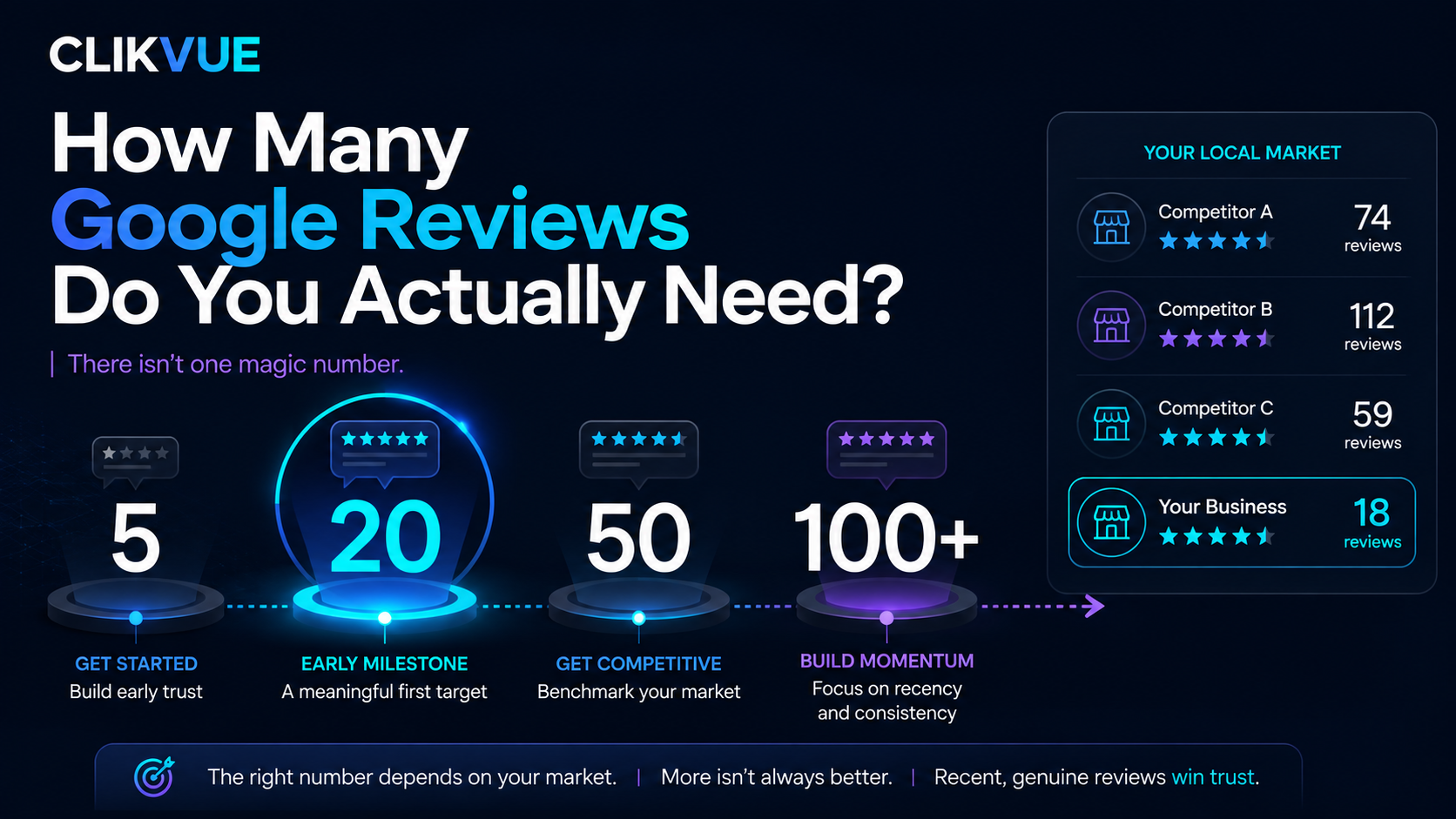
But the customer sees three reviews for your business while the alternatives around you have a much stronger body of recent feedback.
That changes the decision.
Reviews provide something your own marketing cannot: evidence from other customers.
People can read what previous customers experienced rather than relying entirely on what the business says about itself.
Reviews may also contribute to local visibility. Google states that review count and positive ratings can contribute to local prominence.
The aim, however, should not be to chase an arbitrary number.
Look at whether reviews are being collected consistently, whether they are reasonably recent, whether they reflect genuine customer experiences and whether the business responds appropriately when customers leave feedback.
Google allows businesses to ask genuine customers for reviews and provides review links and QR codes for doing so.
What you should not do is buy reviews, reward people specifically for positive reviews or only approach customers you know are likely to praise you.
Google prohibits manipulated or incentivised review activity, and UK consumer law now contains specific rules concerning fake consumer reviews.
Build a process for genuine reviews instead of launching a desperate one-week review campaign every six months.
Use the bottleneck test
You do not need a complicated marketing dashboard to make a useful first diagnosis.
Look at what is already happening.
| What you can see | Likely area to investigate first |
|---|---|
| Hardly anybody discovers the business through search | Google visibility or SEO |
| You appear poorly in Maps for genuinely relevant nearby searches | Google Business Profile / local SEO |
| Your website appears in Search but important pages perform poorly | SEO and content |
| People reach the website but enquiries remain unusually weak | Website and conversion |
| People find you but your online proof looks weak or stale | Reviews and trust |
| Referrals convert well but strangers rarely discover you | SEO / Google visibility |
| Your details differ between your website and Google profile | Fix the foundations first |
| Everything is weak | Build a minimum viable foundation before trying to scale one channel |
The word investigate matters.
One metric rarely proves the cause on its own.
Low enquiries could come from the website, pricing, your offer, seasonality, poor-quality traffic, slow response times or several issues working together.
The goal is to narrow the problem before spending money trying to solve it.
What if everything needs work?
This is common, especially with a new business or one that has relied mostly on word of mouth.
In that situation, do not spend months perfecting one channel while leaving glaring holes everywhere else.
Build a minimum viable online presence first.
Your website should clearly explain:
- what you do
- who you help or where you work
- why somebody should trust you
- how they can contact you
Your Google Business Profile should be claimed where eligible, accurate and properly completed.
You should have a straightforward process for asking genuine customers for reviews.
Then you can start expanding the SEO work that helps more of the right people discover the business.
That does not mean the website must be completely “finished” before SEO starts.
In practice, these areas often develop together.
A new service page can improve the website for potential customers while also giving search engines a clearer page to understand.
Likewise, reviews can improve customer confidence while also contributing to local prominence.
The point is not to create four separate marketing projects.
It is to build one connected customer journey.
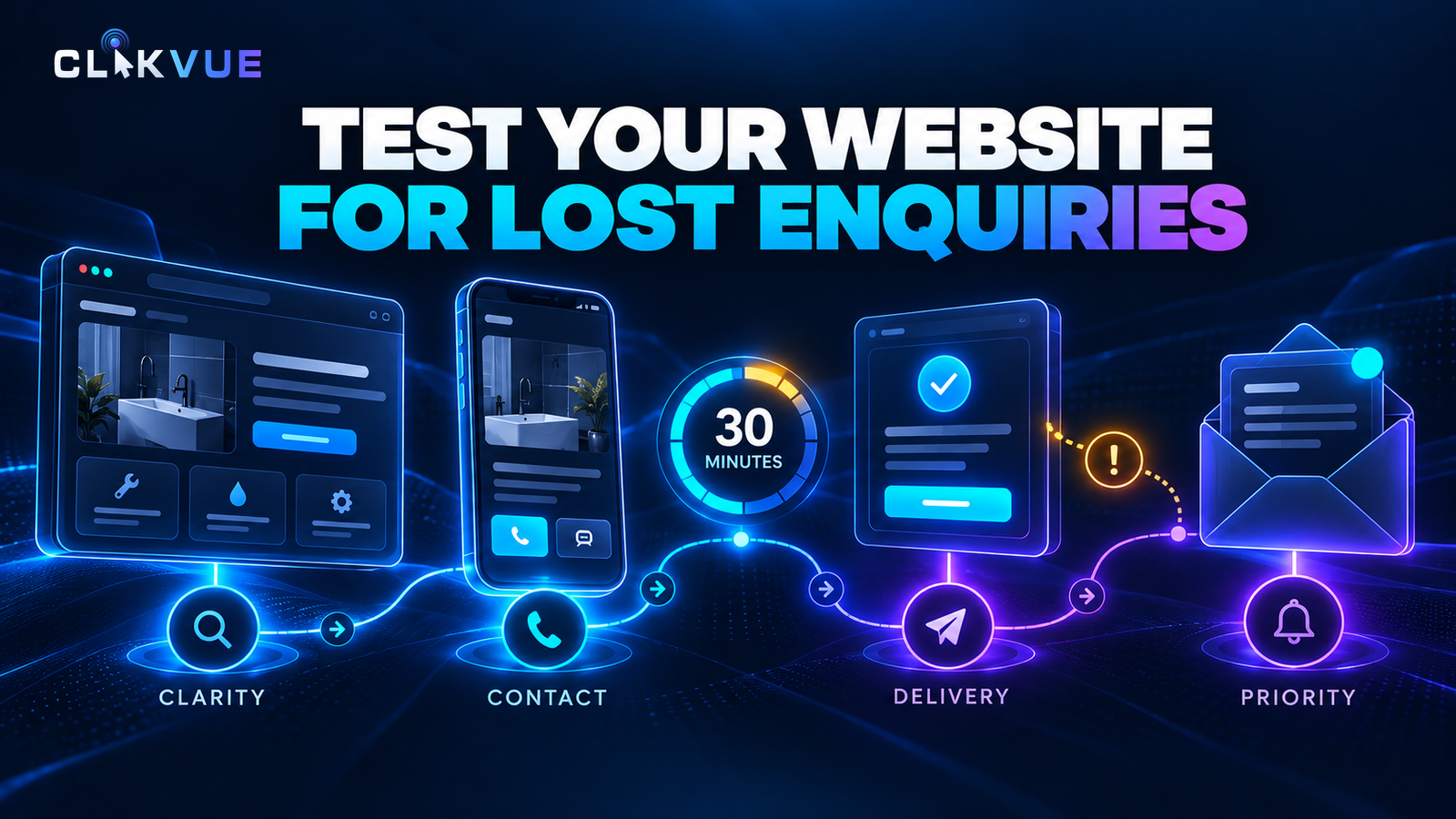
A 30-minute check before deciding what to work on
Before commissioning another website, buying an SEO package or launching a review campaign, spend half an hour looking at the business as if you were a potential customer.
1. Search for the services you genuinely want to be found for
Try realistic service and location searches.
Look separately at local or Maps results and normal organic website results.
Do not judge everything from one search. Search results can vary depending on the query, location and other factors.
2. Open your own website on your phone
Try to forget everything you already know about the business.
Could somebody unfamiliar with you quickly understand:
- what you offer?
- where you work?
- why they should trust you?
- what they should do next?
If not, you have probably found something worth investigating.
3. Look at your reviews as a stranger would
Check the quantity, quality and recency.
Look at whether you respond to reviews.
Then compare the overall picture with the businesses a potential customer is likely to encounter alongside you.
Do not chase a universal “correct” review number.
Context matters far more.
4. Check the evidence behind your assumptions
Google Search Console can show how the website is appearing in Google Search.
Your Google Business Profile also provides information about how people discover and interact with the business.
Use real data where possible rather than deciding that “Google isn't working” based purely on how things feel.
Three businesses could have three completely different priorities
Consider a plumber whose website is simple but clear, who already has strong customer feedback and converts referrals well, yet barely appears for the services and towns they cover.
A complete website rebuild is probably not the first thing to investigate.
Search visibility is.
Now consider a private clinic that appears prominently in local search and receives plenty of website visits, but the website makes treatments difficult to understand and gives visitors almost no idea what happens after they enquire.
More traffic is unlikely to be the first answer.
Website clarity and conversion deserve attention.
Finally, imagine an accountant with a professional website and reasonable search visibility, but only four old Google reviews.
A potential customer comparing several accountants has very little third-party evidence to work with.
Improving the review process could be far more useful than publishing another ten blog posts.
Same four areas.
Three completely different priorities.
Do not optimise the easiest thing just because it feels productive
This is where small-business marketing can become expensive.
Publishing another social post feels easier than rewriting a confusing service page.
Changing website colours feels easier than working out why nobody can find the site.
Buying backlinks feels more concrete than asking whether the content actually answers what customers need.
Collecting reviews feels productive, even if the business still does not clearly explain what it sells.
Activity is not the same as progress.
The most valuable improvement is often the one that removes the largest obstacle between somebody discovering the business and becoming comfortable enough to make contact.
That is why it is more useful to think about your online presence as a customer journey rather than a collection of unrelated marketing jobs.
FIX THE BOTTLENECK.
THEN GROW THE TRAFFIC.
So what should you work on first?
If people cannot find you, investigate Google visibility and SEO.
If people find you but do not understand or contact you, investigate the website.
If they find you and understand you but have little reason to trust you, investigate reviews and the wider trust signals around the business.
And if all four areas are weak, build the foundations before trying to scale traffic.
Your website, SEO, Google presence and reviews should eventually support each other.
They just do not all need to be your number-one priority today.
Not sure where the problem actually is?
That is exactly what the Clikvue Growth Score is designed to help with.
It looks across the main stages of your online presence, including website clarity, Google visibility, trust, reviews and conversion, so you can get a clearer idea of what deserves attention instead of guessing.
Take the free Growth Score assessment
If you would rather have us take a closer look at what potential customers can currently see, you can also request a Clikvue Snapshot Report through our contact page.
Resources
Google Search Central: SEO Starter Guide
Google's beginner-friendly explanation of how SEO helps search engines understand a website and helps people discover it.
View resource →
Google Business Profile: Tips to improve your local ranking
Useful for understanding relevance, distance, prominence and the basic information Google recommends businesses maintain.
View resource →
Google Search Console
Google's free tool for seeing how your website performs in organic Google Search.
View resource →
Clikvue Growth Score
Check website clarity, Google visibility, trust, reviews and conversion together rather than judging one channel in isolation.
View resource →
Sources
Google Search Central — SEO Starter Guide
View source →
Google Search Central — Creating helpful, reliable, people-first content
View source →
Google Business Profile Help — Tips to improve your local ranking on Google
View source →
Google Business Profile Help — How Google sources and uses Business Profile information
View source →
Competition and Markets Authority — Fake reviews
View source →
Competition and Markets Authority — Reviews guidance
View source →
Recent Posts